
Curriculum planning for teachers: From standards to a teachable week
Curriculum planning for teachers made practical: a 5-step weekly system with examples, research links, and templates you can use tomorrow.


In this article8 sections

Step 1 — Curriculum planning for teachers: start with outcomes, not activities
If you begin with activities, your week can fill up before you’ve addressed what students must learn. Backward design flips that order so every minute serves a clear goal.
- What to do: Pull this unit’s standards and highlight what students must know and do. For ELA and math, see the Common Core State Standards. For science, check the Next Generation Science Standards (NGSS).
Why it works: Starting with explicit standards keeps objectives measurable and aligned to your state or district expectations. - What to do: Unpack 1–3 priority standards into student‑friendly learning targets and success criteria (e.g., “I can…,” “You’ll show this by…”). Use the three UbD stages—identify results, determine evidence, plan experiences—as a checklist (ASCD: Understanding by Design).
Why it works: UbD’s backward design reduces busywork and clarifies what counts as evidence before you choose activities. - What to do: Draft a simple performance task or quick assessment for Friday that matches your targets (rubric, checklist, or exit ticket bank).
Why it works: Defining “acceptable evidence” first prevents misalignment and helps you spiral practice toward that outcome all week. - What to do: Note prerequisite knowledge that might block progress (vocabulary, prior skills, safety rules). Plan a 5–10 minute warm‑up to check these on Monday.
Why it works: Catching gaps early avoids midweek reteaching and protects pacing.
Tip
Limit weekly targets to essentials you can actually teach and assess in your available periods. Save nice‑to‑haves for future spirals.

Step 2 — Turn outcomes into a realistic week on your timetable
Great plans collapse when they ignore the clock. Build the week around your real schedule and rotations, not the other way around.
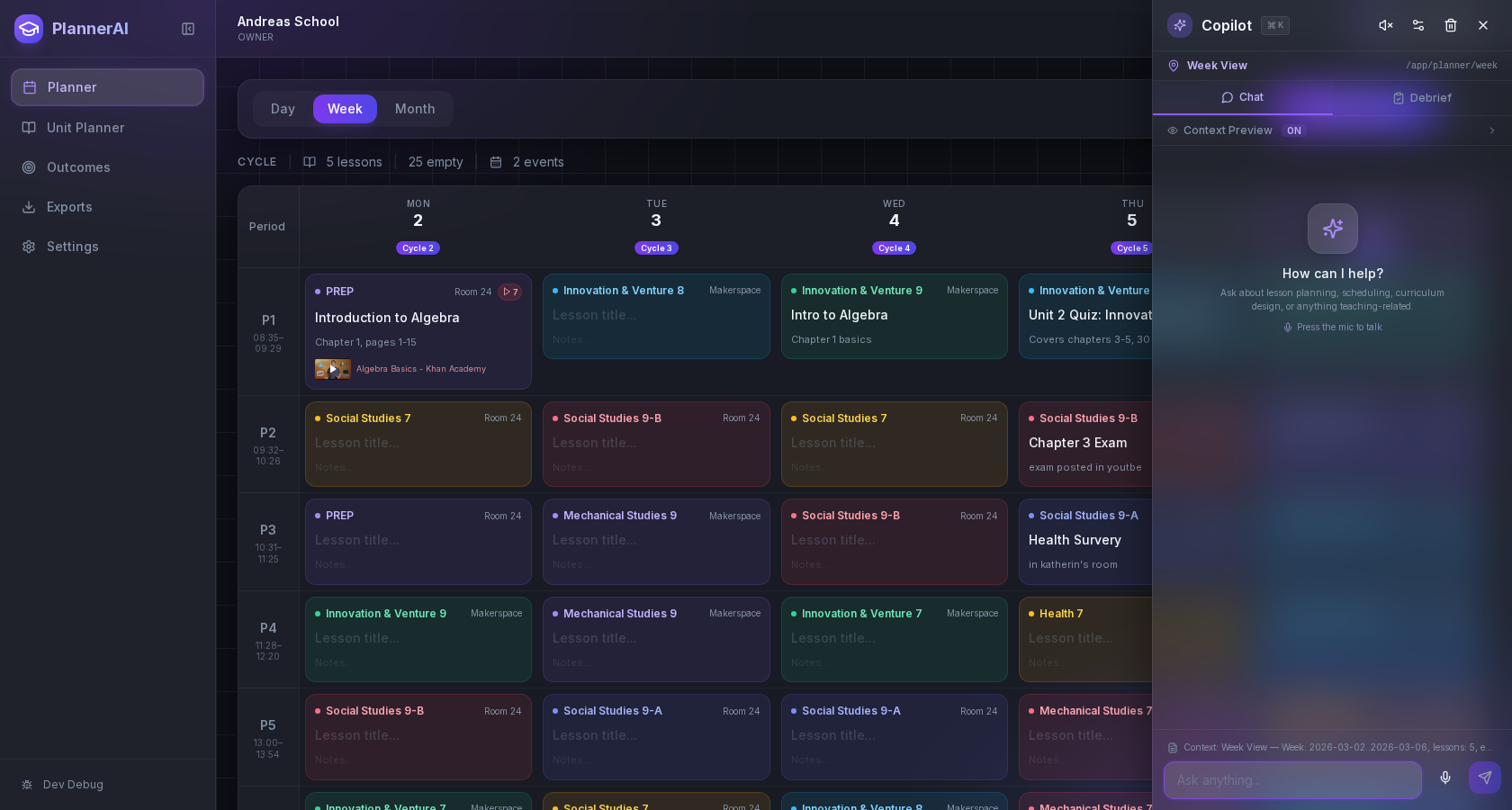
- What to do: Sketch your week with actual periods, rotation days, and known interruptions (assemblies, drills, lab days). If you work on a rotating schedule, see our guide to practical strategies in How to Plan Lessons on a Rotating Schedule.
Why it works: Planning on the timetable prevents over‑stuffed lessons and spreads the workload across the rhythm you truly have. - What to do: Place “anchors” first: Monday prerequisite check, midweek practice set or lab, Friday evidence task. Then block 5–8 minute daily retrieval routines (see Step 3).
Why it works: Anchors protect the essentials and give students predictable routines that lower cognitive load. - What to do: Sequence lessons so complexity increases across the week (model → guided practice → independent application → transfer). Keep transition times realistic.
Why it works: A gradual release arc matches how novices learn: worked examples early, fading support as competence grows. - What to do: Add one buffer slot (10–15 minutes) you can cash in any day for catch‑up or extension.
Why it works: A planned buffer absorbs real‑life delays without sacrificing standards coverage.
Mini‑template you can copy
- Mon: Prior‑knowledge check + core concept A (model) + brief practice.
- Tue: Concept A (guided practice) + retrieval spiral from last week.
- Wed: Concept B or lab/close read (scaffolded application).
- Thu: Mixed practice or stations (interleaving) + feedback cycle.
- Fri: Short performance or exit tickets aligned to targets.
Step 3 — Design each lesson so learning sticks
Small, research‑backed moves make your plan lighter and your students’ learning more durable.
- What to do: Start most lessons with 3–5 retrieval questions targeting last lesson, last week, and last unit. Keep it no‑stakes and fast (whiteboards, mini‑quizzes). For a balanced view of the evidence and classroom use, see the EEF’s review (Cognitive science approaches in the classroom).
Why it works: Retrieval practice and spacing strengthen memory traces and highlight misconceptions early. - What to do: Model with a worked example, then partly completed examples students finish, then independent items. Think aloud once; then fade prompts.
Why it works: Worked examples reduce extraneous load for novices and accelerate problem‑schema formation. - What to do: Interleave practice across related skills (e.g., different fraction types; varied text evidence prompts) once accuracy is stable.
Why it works: Interleaving improves discrimination and transfer, especially when problems look similar but require different moves. - What to do: Build in quick feedback loops: circulate with one success criterion in mind; use whole‑class “reteach in 2 minutes” when a pattern appears.
Why it works: Immediate, targeted feedback is more actionable than delayed marking and prevents error‑practice. - What to do: Close with a 2–3 sentence exit ticket tightly matched to the week’s success criteria. Sort into “Ready / Not Yet” to plan tomorrow’s starter.
Why it works: Fast formative checks keep the plan responsive without adding grading load.
Resource
Short on time? A flexible planner like our lesson planner for teachers lets you duplicate retrieval banks, worked examples, and exit tickets across classes in seconds.

Step 4 — Make learning accessible without re‑planning everything
Universal Design for Learning (UDL) helps you anticipate variability and offer smart options without creating five separate lessons.
- What to do: For each target, add one option for engagement, one for representation, and one for action & expression using the CAST UDL Guidelines (udlguidelines.cast.org). Example: choice of text vs. audio summary; graphic organizer vs. paragraph response.
Why it works: UDL provides evidence‑informed checkpoints to reduce barriers while keeping rigor (CAST UDL Guidelines). - What to do: Plan Monday’s prerequisite check with supports ready: vocabulary cards, sentence starters, manipulatives, or annotated diagrams.
Why it works: Pre‑teaching key concepts lifts access for many students, not just those with IEP accommodations. - What to do: Create a “fast‑finishers that deepen learning” bin and a “just‑in‑time scaffold” bin tied to the same standard (e.g., number lines, mentor paragraphs).
Why it works: You keep everyone on the same standard while flexing the pathway—efficient differentiation. - What to do: Offer at least two ways to show learning on Friday’s task (oral explanation, annotated work sample, or short write‑up), all scored with the same rubric.
Why it works: Multiple means of expression preserve comparability while honoring different strengths.
Note on standards
Standards say what students should learn (e.g., NGSS performance expectations); they don’t prescribe how. Use UDL options to decide the “how” while staying aligned.
Step 5 — Keep it sustainable: templates, teamwork, and quick reflection
A good weekly plan is repeatable. Build habits that save time now and even more next month.
- What to do: Save a one‑page template with your anchors (retrieval, model, guided, exit ticket, buffer). Reuse it for every class with small edits.
Why it works: Consistent structures reduce planning time and help students learn the routine, not just the content. - What to do: Co‑plan once a week: agree on targets, swap worked examples, and share exit tickets. Split the grading of common checks, then discuss patterns.
Why it works: Shared artifacts multiply your time and calibrate expectations across classrooms. - What to do: Track coverage as you go—tick off standards addressed and link to the assignment or evidence. If you prefer a lightweight system, see our tips in How to Track Curriculum Coverage Without a Spreadsheet.
Why it works: Real‑time tracking prevents surprises at report time and guides review weeks. - What to do: End each day with a 90‑second reflection: What to keep, tweak, or drop tomorrow?
Why it works: Tiny, frequent adjustments compound into major time savings and better learning. If you like structured prompts, try the ideas in The Case for Daily Teaching Reflection.
If you use Classroom Radar
Planning on your real timetable, linking lessons to curriculum outcomes, and attaching quick evidence is built in. Radar, the assistant, can turn voice notes into lesson drafts; see ideas across the site or explore when ready.
Frequently asked questions
How do I balance standards with limited time each week?
Prioritize 1–3 essential targets and design a single short assessment for Friday, then choose activities that build toward it. This backward design approach keeps lessons focused and reduces detours.
What should a daily plan include at minimum?
Include a retrieval warm‑up, a brief model or example, guided practice, independent application, and a quick exit ticket. Those five parts fit into most periods and align to how students learn.
How do I handle rotating schedules without losing sequence?
Plan in blocks (A, B, C) rather than by weekdays and place fixed anchors like retrieval and evidence tasks in each block. Map your rotation explicitly so every group eventually meets the same anchor points.
How can I differentiate without writing multiple lesson plans?
Use UDL options: offer two ways to access content and two ways to show learning with the same rubric. Keep the objective constant and vary the path (supports and products).
Do I need to write detailed scripts for every lesson?
No. A concise plan with targets, success criteria, key examples, timings, and an exit ticket is enough for most days. Save full scripts for complex labs, discussions, or new routines.
What if my plan gets derailed by an interruption or misconceptions?
Use your buffer slot and adjust the week’s independent practice to include the missed concept. Quick, same‑day reteaching after a formative check is more effective than waiting until next week.
Plan your week once—teach it with confidence
When you begin with outcomes, place anchors on your real timetable, and lean on a few high‑impact routines, curriculum planning becomes a calm weekly habit rather than a scramble. Use backward design to choose what matters, memory‑friendly lesson structures to make it stick, and UDL options to keep every learner in the game. If you’d like a planner that mirrors your timetable and links lessons to outcomes as you go, you’re welcome to try Classroom Radar at /.
Sources and further reading
- Understanding by Design White Paper — ASCD
- The Standards — Next Generation Science Standards (NGSS)
- English Language Arts Standards — Common Core State Standards Initiative
- Cognitive science approaches in the classroom: A review of the evidence — Education Endowment Foundation (EEF)
- CAST UDL Guidelines — CAST